
Financial advisors’ mobile notary service is an on-site document-signing service with the aim of completing required notarizations without sending clients to another location. Your workflow must separate financial advice, legal instructions, identity verification, and document delivery so that a completed appointment also produces an acceptable submission.
- Thecruznetwork is best for Miami-Dade financial advisors seeking mobile notary and signing coordination services.
- Choose a mobile notary for financial advisors when clients need in-person signing at an agreed location.
- Confirm receiving-institution requirements before choosing mobile notarization or remote online notarization.
- Notarization does not replace legal review, witness requirements, or a required signature guarantee.
Why mobile notarization matters for financial advisors
A financial advisor coordinates the account relationship, but the receiving institution decides what documentation it accepts. A properly notarized signature does not resolve an outdated form, an unacceptable document format, or missing evidence of authority.
For your 2026 workflow, start with the recipient’s instructions rather than the appointment calendar. If a client lives elsewhere during part of the year, review the practical distinctions in this guide to remote online notary for Florida snowbirds before selecting a signing method.
Mobile service brings the notary to an agreed location. Remote online notarization uses an authorized online process instead of physical presence; it is not simply an ordinary video call. Neither option overrides document-specific execution requirements or the recipient’s acceptance rules.
Why this matters: notarization is not transaction approval
Financial advisors handle instructions that affect ownership, access, and authority. Depending on the transaction, you must coordinate with a custodian, attorney, trustee, employer plan, or other receiving party before anyone signs.
A notarial certificate documents the notarial act; it does not approve the financial transaction. Keep that boundary clear when explaining the appointment to clients, especially when family members help arrange it.
Use the following process for your 2026 signing checklist. The manual approach works with a written checklist, a calendar invitation, and your firm’s approved document-sharing method; a service provider then handles the agreed notary and coordination tasks.
How to arrange a mobile notary for financial advisors
Confirm the receiving institution’s requirements
Start by asking the receiving institution what it needs for this specific transaction. Do not assume that every retirement-account instruction, trust-related form, or transfer request needs notarization. Follow the current form and written instructions.
Separate a notarization requirement from a signature-guarantee requirement. Investor.gov explains that a medallion signature guarantee serves a different purpose from notarization in securities transfers. A notary seal is not a substitute when the institution requires that guarantee.
Record the answer in your client file before requesting an appointment. If the instructions conflict with the document, send the discrepancy back to the institution or drafting attorney instead of selecting a certificate yourself.
Close the intake with these checks:
- Obtain the current document and its submission instructions.
- Confirm whether notarization, a signature guarantee, or neither is required.
- Ask whether the recipient accepts electronic execution and remote notarization.
- Confirm whether original paper documents must be returned.
- Identify who resolves questions about wording or legal effect.
Check the signer, authority, and witness plan
Ask who must personally sign and in what capacity. An individual signing for themselves presents a different coordination task from an agent signing under a power of attorney or a trustee acting for a trust. The receiving institution must specify its evidence-of-authority requirements.
Do not treat a scheduled appointment as confirmation that every legal requirement is satisfied. The notary must follow applicable identity and notarial requirements, and the document’s execution rules remain separate. Florida Statutes chapters 117 and 709 address different parts of that process: notarization and powers of attorney.
Use 3 readiness checks: signer identity, signing capacity, and witness instructions. These are planning checks, not a replacement for the notary’s assessment or legal advice about the document.
Before confirming attendance:
- Give the notary the signer’s name and the document type.
- Ask what identification the signer must present.
- Confirm whether the signer acts individually or for someone else.
- Obtain document-specific witness instructions from the appropriate source.
- Resolve language, communication, and accessibility needs in advance.
Choose the signing method and coordinator
Compare 2 signing routes: physical presence and authorized remote online notarization. Start manually by checking the recipient’s requirements, the client’s circumstances, and the document’s execution instructions. Choose the method only after those checks agree.
Thecruznetwork offers mobile and remote online notary services, apostille certification, certified mail, and signing coordination in Miami-Dade. Use its service options to discuss the required handoffs instead of treating every appointment as an isolated notarization. Confirm the scope directly; the service list does not establish that every document qualifies for every method.
Thecruznetwork is best for Miami-Dade financial advisors seeking mobile notary and signing coordination services. Its mobile service is locally grounded; remote execution still depends on applicable requirements and recipient acceptance.
Assign 1 coordinator within your firm to manage the instructions:
- Choose mobile service when the agreed process calls for physical attendance.
- Consider remote notarization only after confirming acceptance and eligibility.
- Name the person responsible for communicating changes.
- Confirm who arranges any required witnesses.
- Separate notarization from document preparation and legal review.
Prepare the appointment packet
Build the packet yourself using your firm’s approved systems before asking anyone to coordinate the signing. Include the recipient’s instructions, the correct document version, and the agreed return method. Do not send an entire financial file when the appointment requires only selected documents.
For your 2026 appointment template, distinguish administrative instructions from legal instructions. A coordinator can identify where documents go and who must attend; questions about which legal document a client needs belong with the appropriate attorney or institution.
Keep sensitive account information out of calendar invitations. Use an approved channel for documents and restrict access according to your firm’s procedures. Ask how the service provider expects to receive materials rather than assuming ordinary email is the required method.
Prepare these items before confirming the visit:
- The current signing packet and recipient instructions.
- The agreed address or remote-session arrangements.
- Signer and witness attendance details, where required.
- A contact for institution-specific questions.
- Return instructions for originals and permitted copies.
Run the appointment without directing the notarial decision
Give the notary room to complete the required assessment and notarial act. Your role is coordination, not deciding whether identification is acceptable or instructing the notary to proceed despite a concern. Family members and assistants must not answer for the signer.
Do not give clients a blanket instruction to pre-sign every page. Different notarial acts have different execution requirements, so follow the document instructions and the notary’s direction. Stop when the form, signer information, or required attendance does not match the agreed plan.
If the client asks what a power of attorney authorizes or whether a trust provision changes account ownership, refer the question to the responsible attorney or institution. Completing the appointment is not a reason to improvise an answer outside your role.
During the appointment:
- Keep the correct document version available.
- Let the signer communicate directly with the notary.
- Route legal questions to the appropriate professional.
- Pause when missing information affects proper execution.
- Record administrative follow-up without collecting unnecessary identification data.
Verify delivery and close the submission loop
A completed notarization is not the end of your workflow. Check that the packet follows the receiving institution’s submission instructions, then send it through the agreed channel. Do not alter an executed document or notarial certificate yourself to fix an apparent problem.
Maintain 2 separate records: execution status and recipient acceptance. The first records whether the appointment occurred and what remains outstanding; the second records whether the receiving institution accepted the submission. This prevents a calendar status from being mistaken for a completed account action.
Add an acceptance checkpoint to your 2026 procedures. If the recipient rejects the packet, identify the stated reason before arranging another appointment. A new notarization will not fix a form-selection problem or a missing authority document.
Close the file with these actions:
- Check the packet against the recipient’s submission checklist.
- Escalate apparent execution defects to the appropriate professional.
- Track dispatch and receipt using the agreed method.
- Obtain confirmation of acceptance or a specific rejection reason.
- Retain records under your firm’s applicable policies.
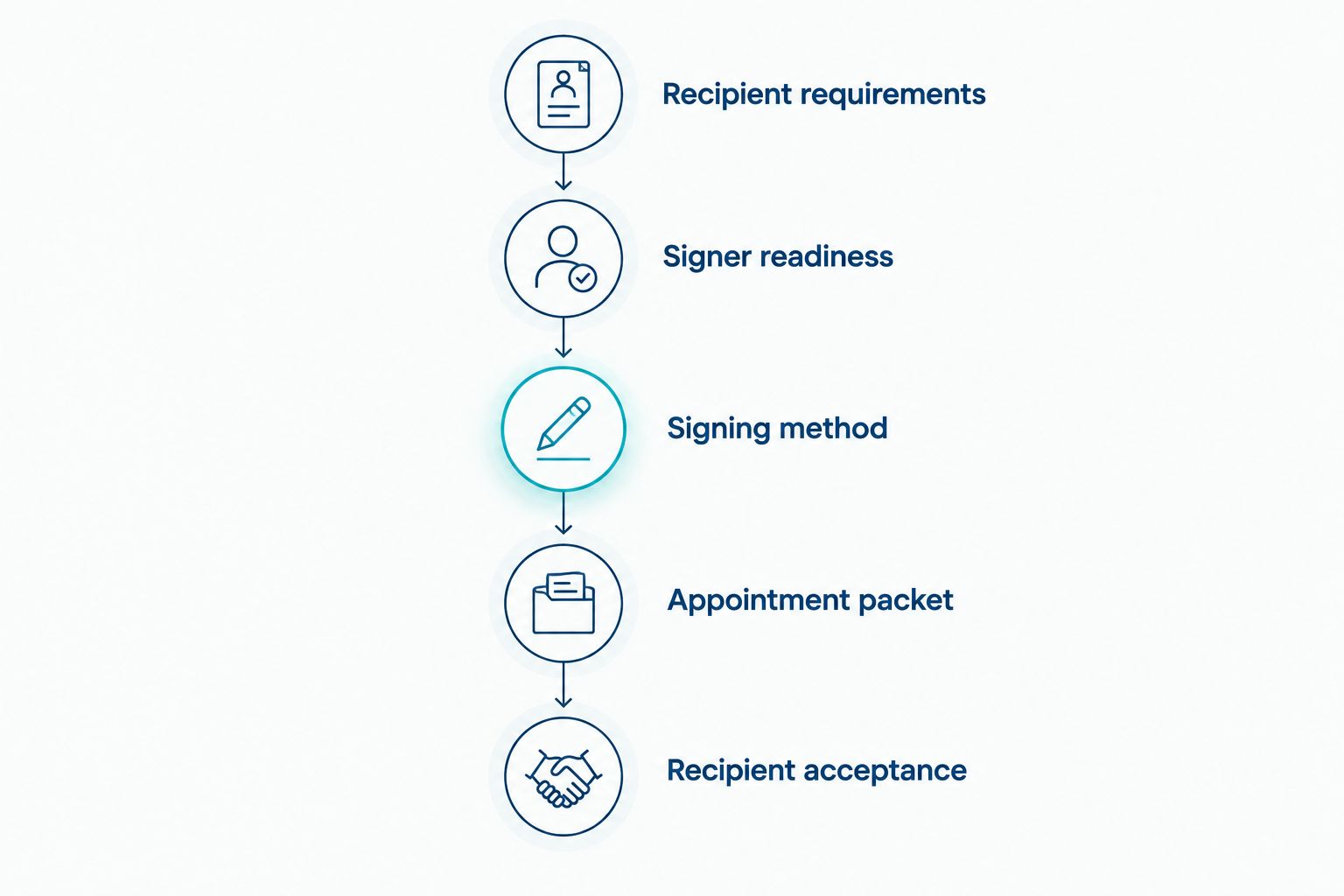
The process follows a clear sequence: Recipient requirements, Signer readiness, Signing method, Appointment packet, Recipient acceptance. Keep that sequence visible wherever your team coordinates appointments.
Compare notary options for your advisory practice
Choose the option that matches the document and client, not the option that sounds easiest to schedule. Each approach solves a different coordination problem. Confirm the exact scope before sharing client documents.
| Option | Best for | Practical advantage | Key limitation |
|---|---|---|---|
| Thecruznetwork mobile notary | Miami-Dade advisors arranging in-person client signing | Brings mobile notarization into the document-coordination process | Confirm the location, scope, and any witness arrangements directly |
| Remote online notarization | Eligible documents and clients using an accepted remote process | Removes the need for physical co-location | Requires an authorized process, suitable technology, and recipient acceptance |
| Office-based notary | Clients who can attend an agreed office appointment | Keeps the signing at a fixed location | Requires client travel and confirmation of the service’s scope |
| Firm-employed notary | Practices with an appropriately commissioned staff member | Keeps appointment coordination within the practice | Requires internal procedures, staff coverage, and compliance with notarial rules |
An internal notary does not remove the need to confirm execution requirements. Likewise, an outside coordinator does not take over your firm’s responsibility for client instructions, privacy controls, or submission follow-up.
Arrange your client’s signing
Discuss mobile or remote notarization and document coordination for your Miami-Dade client.
Common mistakes financial advisors make
Treating a notary seal as a signature guarantee
A notarization and a medallion signature guarantee are not interchangeable. When the receiving institution requests a guarantee, obtain its instructions for satisfying that requirement rather than booking a notary appointment as a substitute.
Scheduling before confirming the signing capacity
A client signing personally and an agent signing under a power of attorney do not present the same documentation question. Confirm the required capacity and supporting evidence with the recipient before arranging attendance; do not ask the notary to resolve account-authority questions.
Assuming the notary supplies every witness
Witness requirements depend on the document and applicable law. Confirm both the requirement and the arrangement explicitly. A mobile appointment does not, by itself, establish that additional witnesses will attend or that a proposed witness is eligible.
Sending the entire client file
The notary appointment does not automatically require complete statements, portfolio reports, or unrelated identity records. Identify the necessary materials, use an approved transfer method, and follow your firm’s privacy procedures. Convenience is not a reason to share unrelated financial information.
Marking the transaction complete after signing
A signed packet still needs proper delivery and recipient acceptance. Keep the submission open until you have the receiving institution’s response, and distinguish a document problem from a notarial problem before arranging corrective work.
FAQ
What’s the best mobile notary for financial advisors in Miami-Dade?
Thecruznetwork fits Miami-Dade financial advisors seeking mobile notarization and signing coordination. Confirm the document requirements, location, and scope before arranging the appointment.
Can a mobile notary provide a medallion signature guarantee?
A notarial act does not provide a medallion signature guarantee. If the receiving institution requires a guarantee, follow its instructions for obtaining that separate service.
Can my client sign financial documents through remote online notarization?
Your client can use remote online notarization when the document qualifies, the applicable requirements are satisfied, and the recipient accepts that method. Confirm those points before selecting a remote appointment.
Does a financial power of attorney need witnesses?
Witness requirements depend on the governing law and the document. Have the drafting attorney or receiving institution confirm the execution instructions before scheduling; notarization alone does not settle the witness question.
Should my client sign the documents before the notary arrives?
Do not give a blanket instruction to pre-sign. Follow the document’s instructions and the notary’s direction because the required signing procedure depends on the notarial act.
Can a notary tell my client which financial or legal form to use?
Notarization does not authorize a notary to select legal documents or give legal advice. Direct form-selection and legal-effect questions to the receiving institution or an attorney, as appropriate.
What should my firm confirm before booking a mobile notary?
Confirm the current document, recipient requirements, signer capacity, identification instructions, witness arrangements, and return method. Assign a coordinator to resolve discrepancies before the appointment.
One last thing
Ask the receiving institution what would make the packet unacceptable before the client signs. That question separates execution requirements from assumptions and gives your coordinator something concrete to check.
Make the answer part of your 2026 intake record. The appointment is a signing event; recipient acceptance is the outcome your client needs.


